
Origin of the Fiber: The Evolution of Andean Camelids
The Global Camelid Family
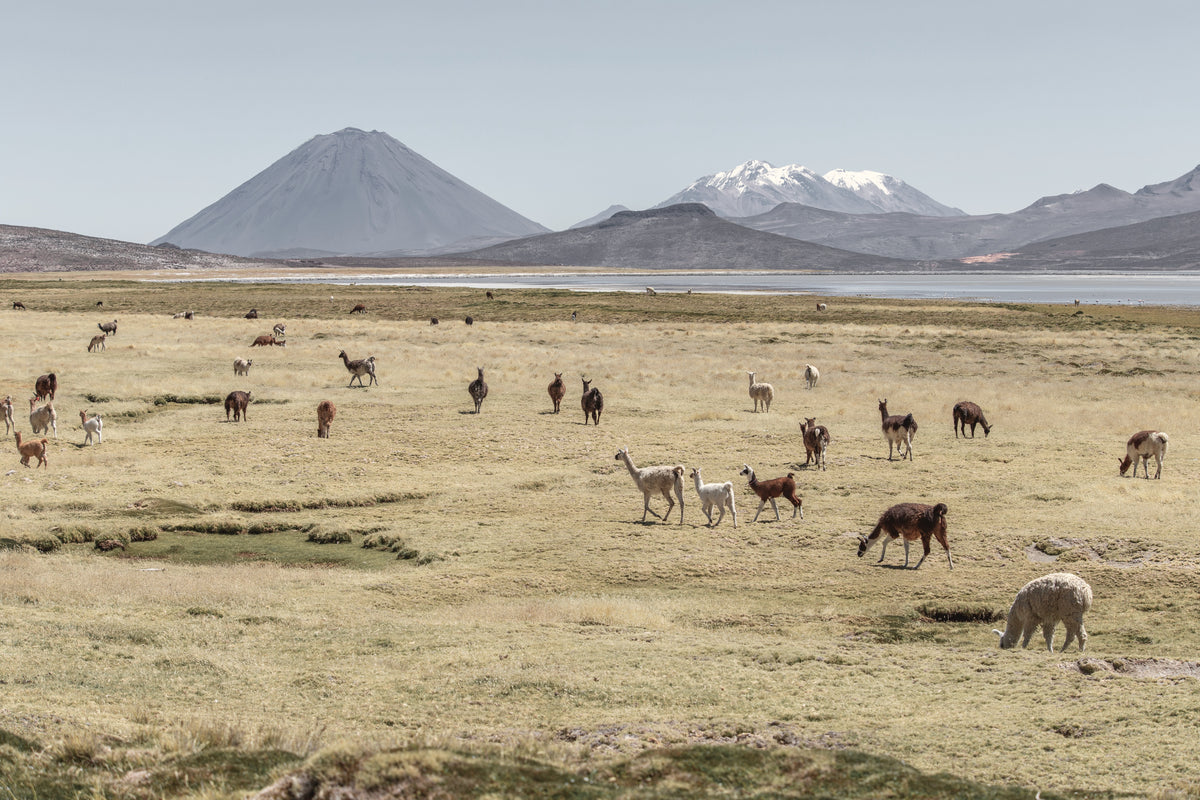
To understand the essence of the finest Peruvian textiles, one must look to the rugged, majestic heights of the Andes. At an altitude of over 4,000 meters, where the air is thin and the climate extreme, a fascinating family of animals developed. Their adaptation to this landscape produced the most resilient yet softest natural fibers in the world. These are the South American camelids, which have formed the cultural and textile heart of Peru for millennia.
Often, the term "camel" is primarily associated with the large desert animals of Africa and Asia, but the biological family of camels (Camelidae) comprises seven species worldwide. It is divided into two large geographical groups. The Old World camels include the one-humped dromedary (Camelus dromedarius) as by far the most common representative worldwide, the mighty, two-humped Bactrian camel (Camelus bactrianus), and the rare wild Bactrian camel (Camelus ferus). These species are native to the deserts and steppes of the Eastern Hemisphere. The second group, the New World camels, lives exclusively in South America. These are the four animals that form the lifeline of the Peruvian highlands.
The Peruvian Andes hold a unique position in this regard. This geographical and cultural density is the result of millennia-old respect and knowledge, passed down from generation to generation in Peru. The following overview introduces the four animal species and explains why only Vicuña and Alpaca fibers are selected for APUKAI's editions.
Vicuña
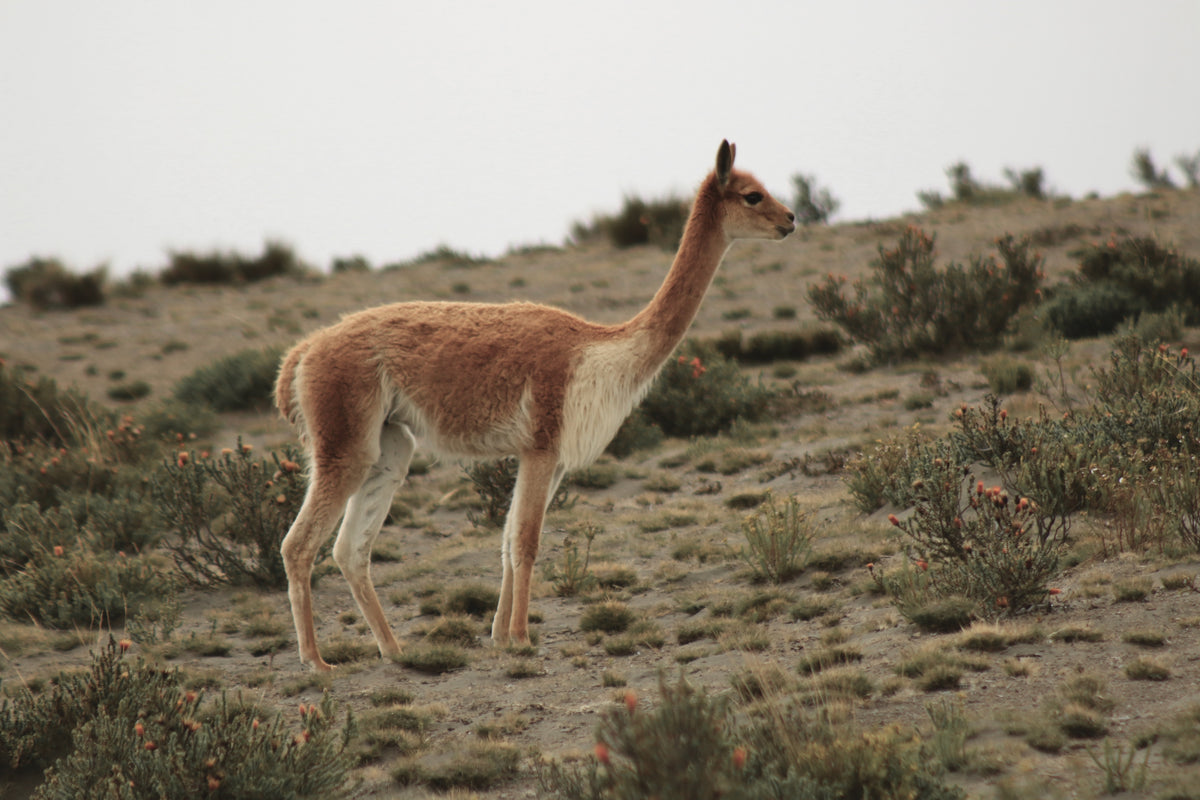
The vicuña (Vicugna vicugna) embodies the wild originality of the high Andes. It is the smallest member of the camelid family and has never been domesticated. It lives wild and free in the barren Puna highlands. To survive the icy nights, the vicuña develops an extremely dense, feather-light undercoat. It is the biological gold standard of natural fibers.
As the fiber is an absolute biological rarity, Peru now acts as the undisputed conservation center for this species: The country is home to over 80 percent of the world's wild vicuña population. To this day, the wool is obtained through strictly regulated, traditional shearing processes. For APUKAI, vicuña represents the ultimate promise of purity and exclusivity. It is the raw material for our absolutely limited vicuña editions.

Alpaca
The alpaca (Vicugna pacos) is the cultivated masterpiece of Peruvian textile history. It evolved from the wild vicuña. Over centuries, the indigenous peoples of Peru purposefully domesticated the alpaca to perfect its fiber. Approximately 87 percent of the world's alpaca population lives here, cultivated in symbiosis with indigenous communities.
The result of this centuries-long dedication is a fiber of remarkable resilience and astonishing thermoregulation. The fine hollow spaces inside the fiber trap air, creating a highly effective, almost weightless protection against cold. We appreciate this unadulterated variety and masterful softness. Alpaca forms the timeless heart of our collections.

Lama
The llama (Lama glama) is the largest and strongest representative of the South American New World camelids. Historically, it was primarily bred as a resilient pack animal for the steep mountain trails of the Inca Empire. To this day, it plays a central role in the daily lives of indigenous Andean communities.
The use of its fiber also follows this tradition: since the llama's fleece is very robust and strong, the wool is primarily processed into durable utility textiles such as dense blankets, ropes, or carpets. For fine clothing, the llama plays hardly any role even in Peru. Therefore, in our editions, we focus entirely on the supple softness of alpaca and vicuña.

Guanaco
The guanaco (Lama guanicoe) is the hardy wild relative of the llama. While the vicuña dominates the Peruvian highlands, the guanaco primarily roams the vast, rugged steppes of southern South America. It is the continent's survivor, native as far south as Patagonian Tierra del Fuego. Over 90 percent of all guanacos live in southern Argentina and Chile, while only a very small protected population exists in Peru.
Although its fiber is of enormous quality, Peru lacks the historical and artisanal infrastructure for its processing. The centuries-old mastery of Peruvian weavers and knitters is instead inextricably linked to the fibers of the Andean highlands.